
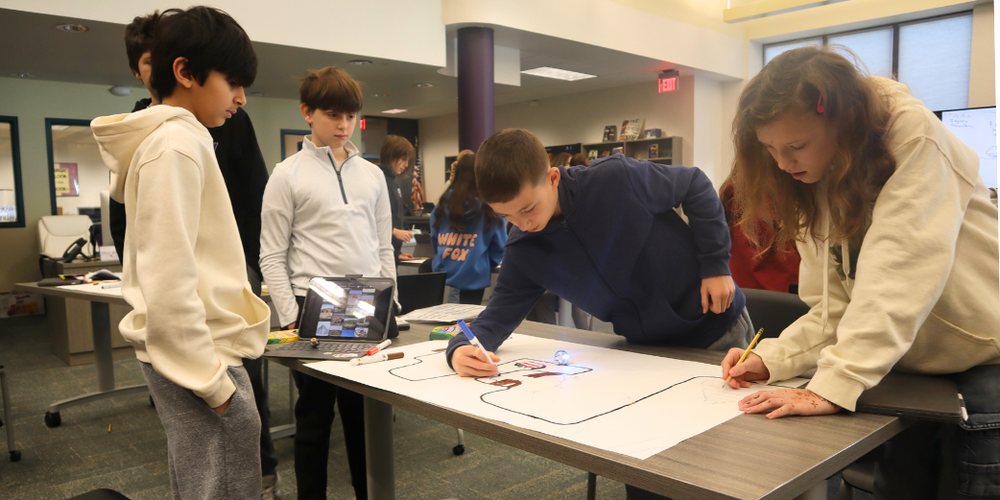
Teams of sixth graders sat at tables throughout the library, immersed in planning the worst Ancient Mesopotamian pilgrimages, ever. A herd of cows blocks the travelers’ way, a dust storm swirls up, an angry shopkeeper chases them out of the bazaar …
Each team’s task was to plan a unique route to a ziggurat—an Ancient Mesopotamian temple—on poster-sized paper. What made it more fun was that the route would be followed by a small robot, called an Ozobot. The students were not only planning the obstacles but also using basic coding skills so that their Ozobot would twirl in a dust storm, zig zag through mountain passes, and detour around an avalanche.
“The project provides students with an authentic learning activity to show their knowledge of what life in an ancient Mesopotamian village might look like,” said teacher Marcia Daley-Savo. “Students are working with the Engineering Design Process in their technology classes. They are using this learning as they create, test and modify their Ozobot maps.”
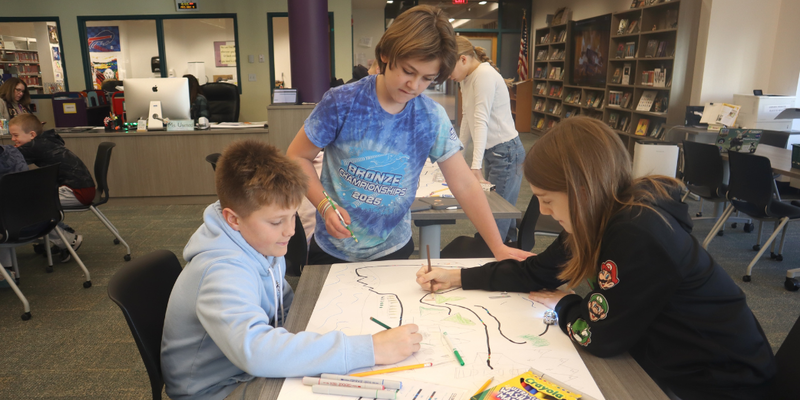
The multi-faceted project to had something to engage each student.
JuJu said that she loved coding the Ozobot. “It was fun to do it over and over again and finally make it work.
Some students sketched key geographical features including the Tigris and Euphrates Rivers and the Zagros Mountains. Other students focused on the obstacles Ancient Mesopotamians encountered. Nathan drew a washed-out bridge; Kirin researched what a dust storm would look like.
Some drew in cultural aspects such as an Ancient Mesopotamian house and a ziggurat.
“The common people stayed at the bottom,” said Dru, “only priests went to the top.” She pointed to the ziggurat’s stairs. “When the priest came back down, it was kind of a red-carpet moment.”